
The Egryn Lights
One of the most intriguing stories to emerge from the 1905 Revival is that of an unknown farmers wife who became a leading revivalist figure and the mysterious lights that followed her every move.
For her first 35 years Mary Jones had lived a quiet, nondescript life content with her place in the world. The events of the 1905 Revival would change this. The small, quiet woman from Islaw'rfford was inspired to become one of Wales’ most famous preachers.
Who Was Mary Jones?
Born to Morris and Anne Powell in Bontddu, a mining community on the northern side of the Mawdach Estuary, Mary was still a baby when the family moved to Sarnfaen farm, near Talybont.
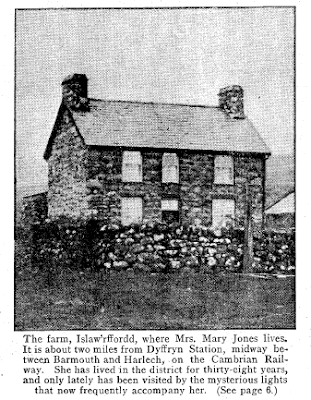
On the 16th of November 1887, nineteen year old Mary married Richard Jones, a farm servant employed on her aunt’s farm. Following the marriage, the couple moved to the nearby Islaw’rfford Farm.
Over the next few years, the young couple were blessed with two children, Richard and Annie. Tragically, Richard died in 1893 at the age of six. The loss hit Mary hard.
Her depression worsened when her sister died soon afterwards. A regular chapel goer all her life, Mary turned her back on her faith.
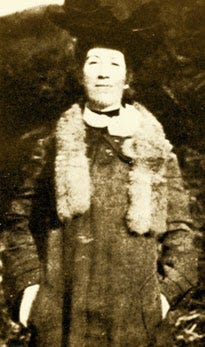
For months, Mary found herself unable to pray or attend services at Egryn chapel. Meanwhile, in South Wales, a Revival was beginning.
Mary Rediscovers Her Faith
Mary’s life was changed one night late in 1904 when she picked up a recently published book. ‘In His Steps’ by the American Congregational minister, C. M. Sheldon would became a cornerstone of the Social Gospel movement.
Imagining what would happen if a group of Christians took seriously the call to discipleship, the book continues to influence worship to this day, most notably through the recent ‘What Would Jesus Do?’ movement. It also inspired Mary. She purchased more copies of the book to give to her friends and family. She also returned to Egryn Chapel.
At the chapel, Mary heard of Evan Roberts’ work and the South Wales Revival.
The Lights Begin to Appear
On the 5th of December 1904, a sparsely attended Revival meeting was held at Egryn Chapel. As she walked to the meeting, Mary saw a bright light in the sky.
Journalist Beriah G. Evans, who attended many of the Revival meetings led by Mary, later described the light, or star, as being “preceded by a luminous arch like a misty rainbow, one end resting on the sea, the other on the mountain top, and bathing in a soft effulgence the roof of the little chapel where she commenced her work that night.”
Interestingly, Mary wasn’t the only person to see the light. A number of people in Egryn, Bryncrug and even Towyn also reported seeing a brilliant white ball lighting up the sky and showering a fiery rainbow of colourful sparks onto the mountain below.
Later descriptions of the light would describe “bottle or black person” in its centre. Around it, smaller lights of many colours were scattered.
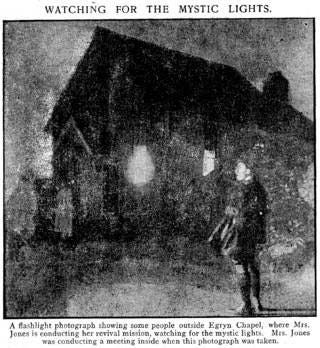
Mary interpreted the light as a sign from the Holy Spirit. Its presence would become a defining hallmark of her mission.
In the meeting that followed, Mary found herself able, for the first time in her life, to vocally express her faith. The few people present were moved by Mary’s words, and soon word began to spread.
Three days later, a second Revival meeting was held at Egryn Chapel. With news of Mary’s vision spreading through the neighbourhood, this meeting was far better attended. It was also led by Mary; the small chapel had no regular minister so congregation members often led the service.
Mary would become increasingly prominent in the chapel’s leadership. Under her guidance, the small congregation began to gather more regularly.
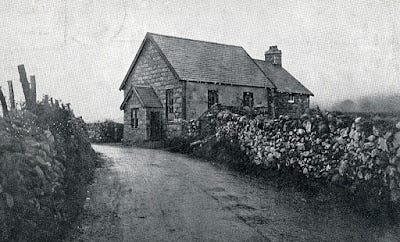
Mary continued to regularly see lights rising from the sea or shore and hovering over the chapel. She interpreted them as a sign of how many people would be ‘saved’ at the next Revival meeting. This number would then be called out at the next meeting. More often than not it was right.
At one evening meeting, Mary predicted that four people would be saved. However, when asked, only three declared themselves. The rest of the congregation were already members. Confused, Mary asked again. In the silence that followed, the vestibule door opened and a stranger entered. They had been listening to the meeting from outside and wished to join the congregation. The strangers entry brought the total saved that night to four.
In total, fifty-one people converted within the first fortnight.
The Egryn Prophetess
The lights quickly became a key feature of Mary’s ministry. Her interpretation of them would see her dubbed the ‘Seer of Egryn’ or the ‘Egryn Prophetess’.
As word spread further afield of Mary’s ministry, more people were drawn to the area, and to the Revival movement.
Soon, the press began to report on the events at Egryn. Early reports focused on Mary and the effect she had on the congregation. Newspaper reports would mention her handkerchief becoming soaked with tears as she wept for those who were lost and prayed for the Lord to use her for his own ends.
Beriah G. Evans, described realising “how intense must be her belief in the efficacy of intercessory prayer, and how real to her must be the presence of her Saviour.” Evans also recorded the effect prayer had on Mary; “the upturned face became transfigured before our eyes. It not merely shone, it actually radiated light”.
Away from the prayer meetings, people also noticed a change in Mary. A previously meek, mild woman, she became more confident, an almost powerful figure.
Evans’ accounts of the Revival also mentioned the lights. He claimed that wherever Mary went a “mysterious protecting light” followed. Interestingly, Evans observed that Mary was so convinced of the divine nature of the lights that she wouldn’t leave the house to carry out her mission until they appeared.
The Mysterious Lights
Most reports of the lights came either from people connected to Mary’s Revival meetings. Beriah G. Evans was travelling with Mary Evans from Islaw’rfford to Egryn Chapel on the 31st of January when they saw five lights.
Soon afterwards, an article written by Evans on the lights and Revival was published in the Daily News. This alerted the national press to the phenomenon, prompting both the Daily Mirror and Daily Mail to send journalists to North Wales.
The interest of the national press marked a turning point in coverage of the Revival. From then on reports would focus increasingly on the lights, overshadowing the ministry of Mary Jones and the Revival.
On the 11th of February, Brian Redwood, the Daily Mail reporter saw lights above Egryn Chapel. At the time, Mary Jones was at Bontddu, around 8 miles away.
On another occasion, Redwood was travelling to Barmouth with Mary Evans, when a strange orb of light hovered above their carriage.
Redwood, along with two others, attempted to conduct a scientific investigation into the lights around Egryn Chapel. Their efforts only resulted in a distant flash to the north; at the time Mary Jones was in a village 15 miles away.
The Daily Mirror journalist also saw the lights; he was among a group of people who saw a bar of light above Egryn Chapel. Interestingly only some of the people in the group saw the light; others a little further away didn’t see anything.
While many sightings had links to Mary, reports were also made by people unconnected to the Revival. In early January 1905 a man reported three lights in a formation similar to the Prince of Wales’ feathers, hovering above a farmhouse.
The sighting was corroborated by a woman, who also saw the lights as she travelled along the Dyffryn to Llanbedr road.
On another occasion, P.C. Jones, of Dyffryn saw a flashing light as he travelled along the road between Egryn Chapel and Dyffryn. At first he assumed it was a bike lamp but soon realised that the light was above the wall and radiating in all directions. The light appeared to light up the spot as if it were midday.
As Jones approached the light, three columns of copper fire shot from the wall and disappeared. Perplexed, Jones inquired at nearby farms, but could find no satisfactory explanation for what he had seen.
The Lights Begin to Spread
As Mary began to travel further afield, sightings of the lights also began to spread.
On the 19th of April, a group of people reportedly spent two hours standing on the northern end of the Pontcysyllte Aqueduct watching lights dance over the Dee valley. One of the group described “a large ball of fire rise from the earth and suddenly burst luridly” on two occasions.
The group agreed that the activity focused on the fields around Argoed farm. Unbeknown to them, Mary Jones was in the area at the time.
Similarly, on the 25th of March, Mary was leading a meeting at Capel Bethel in Llanfair when a number of people outside the chapel saw lights springing from an adjacent field.
When Mary travelled to South Wales to extend her ministry, the lights followed. People who had attended a prayer meeting in Ystrad, in the Rhondda Valley, noticed lights on the nearby Penrhys Mountain. A few days later, on the 27th of May, while Mary prayed nearby lights were reported in Libanus.
What Were the Lights?
That the lights seemed to focus around Mary Jones initially helped to strengthen the Revival. Many believed that the lights were a sign of the divine. Others sought a more rational explanation.
In 1983, an article in New Scientist theorised that the lights were a naturally occurring phenomenon known as ‘earth lights'. A phenomenon often witnessed near geological fault lines, it is thought that the friction created by rocks rubbing against each other under intense pressure sends lights into the atmosphere.
The Mochras Fault which runs parallel to the Cardigan Bay coast, links Harlech to Barmouth. It also passes close to Egryn Chapel. Could this have been the cause of the mysterious lights?
Interestingly, this wasn’t the first time that mysterious lights had been reported in the area. In 1662, people in Harlech saw strange lights above nearby fields. People standing in the fields, watching the lights, were unharmed, but the grass around them was infected. The lights also, reportedly, set fire to nearby crops and barns.
Just over 200 years later, in 1887, people reported seeing blue lights hovering over Pwllheli and the Dysynni Estuary.
Other possible explanations for the lights include the ignition of marsh gas, luminous insects, St Elmo’s fire or the Aurora Borealis.
While one, or a combination, of these theories could explain the lights witnessed in Egryn, it doesn’t explain why they seemed to follow Mary when she travelled around the country. Something that could explain this is mass hysteria.
With the Revival at its peak, many people were desperate for a sign. In such an atmosphere, people began misinterpreting any light they saw as an indication of the divine.
Certainly, some of the reported sightings of strange lights were found to have a rational explanation. For example, when Mary was conducting her ministry in Carmarthenshire, people reported seeing mystery lights in the hills nearby. Upon closer inspection, the lights turned out to be a local farmer burning gorse. On other occasions, oil lamps in windows and motorcar headlights were found to be the source of the lights.
It should also be noted, that the lights didn’t appear every time Mary preached.
While interest in the lights threatened to become a distraction from the Revival; Mary Jones focussed on her message. She travelled Wales and southern England, praying, tending to the sick and visiting the poor.
As 1905 wore on, interest in the lights, and the Revival, began to fade.
After The Revival
As the Revival lost momentum, Mary returned home to her family. Soured by the cynical recations of some, she became something of a recluse, turning her back on religion.
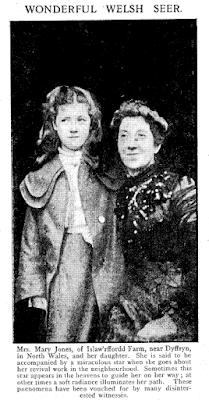
Over the passing of time, the story of Mary Jones and her role in the 1905 Revival has been pushed to the margins. This is partly because of the supernatural phenomena that came to be associated with her ministry. At times, this became more important than the personal transformations many underwent at her meetings. However, those who Mary helped, fondly remembered the softly spoken farmers wife from Islaw’rfford.
Following her husband’s death in 1909, Mary continued to live at Islaw’rffordd until her own death in 1936 at the age of 68. She was buried in the family grave at Horeb Chapel, Dyffryn. Despite 30 years passing since the height of Mary’s fame, her funeral was one of the largest ever seen in North Wales.